







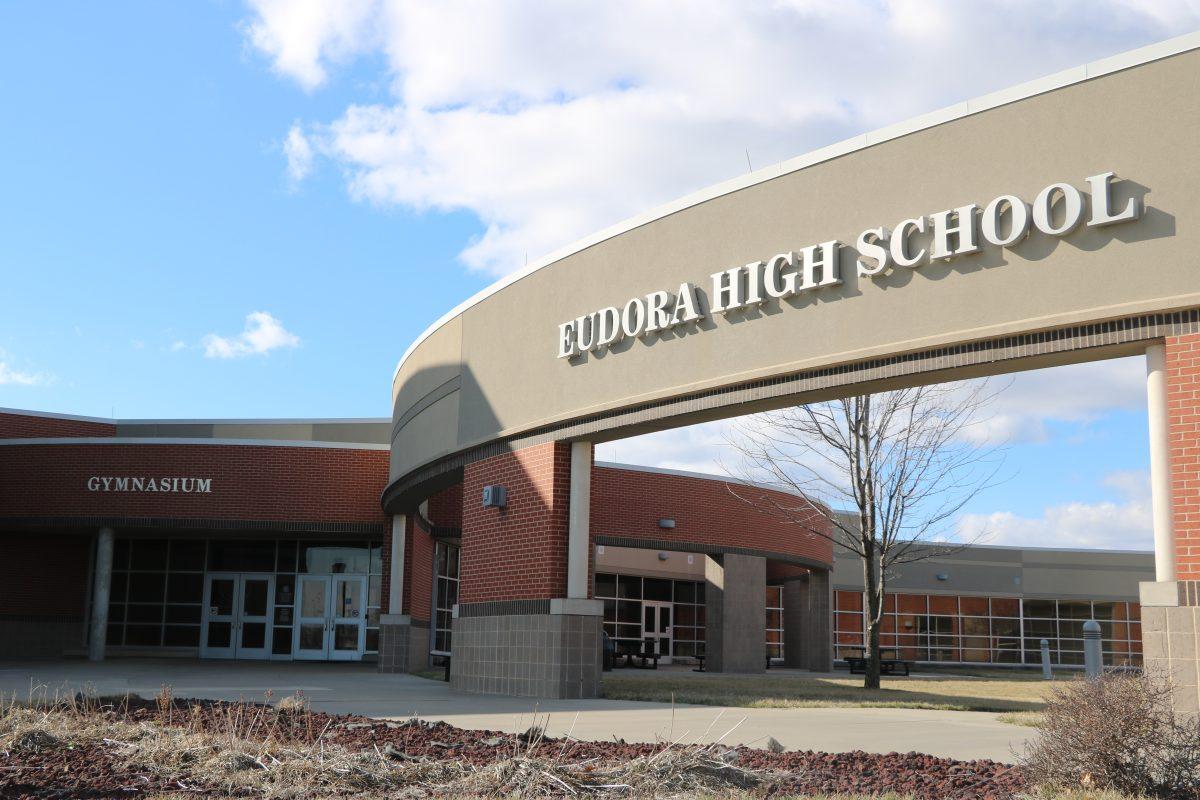





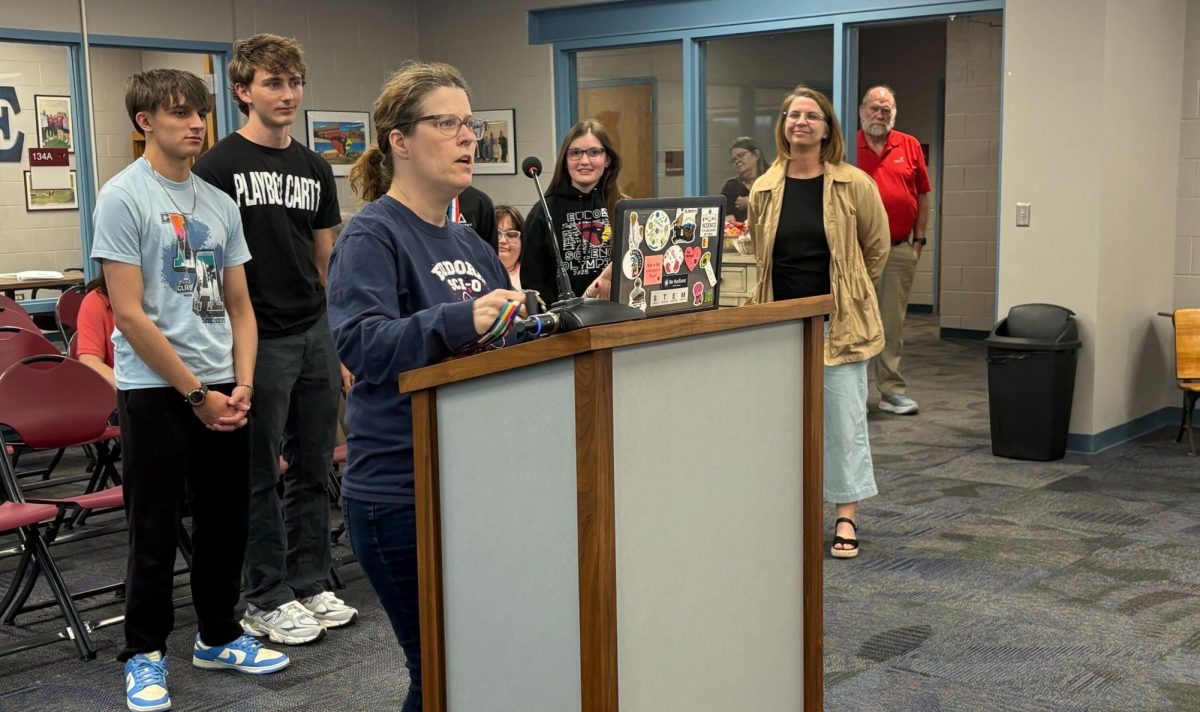
High school students from various organizations were honored for their success in state competitions at the School Board meeting Thursday night.
Three students qualified to compete in the national HOSA-Future Health Professionals competition this summer in Indianapolis. Maddie Chacon will be competing in patient care tech, Milkana Maneva in pharmacology and Dylynn Jayne in the surgical technologist category.
The board also recognized the four gold medalists in the SkillsUSA competitions. Colton Jenkins is a two-time gold medalist in technical drafting.
Freshmen Aubriella Curnes, Maggie Gabriel and Ellie Moore won gold in the promotional bulletin board leadership contest. Adviser Scott Lickteig said they made and presented a bulletin board related to the theme, “Champion Your Future,” and scored 95%.
The gold medalists will head to Atlanta in June for the national competition.
Five students qualified for the all-state band, director Damian Johnson said. They are senior trumpet player Eugene White, junior oboe player Felicity Speidel, junior tuba player Luke Watts, sophomore euphonium player Daisy Mack and freshman clarinet player Amelia Fortner.
One of the pieces the students played was written in memory of a student who passed away from cancer, Johnson said. Eudora students got to meet the student’s father before they performed their concert. He is also a band director and conducted a piece with them.
“There wasn’t a dry eye in the place,” Johnson said. “The music just hits a little bit differently.”
Science Olympiad was also recognized for winning first overall in the small schools category.
Scholars Bowl was recognized for winning a third-straight state title.
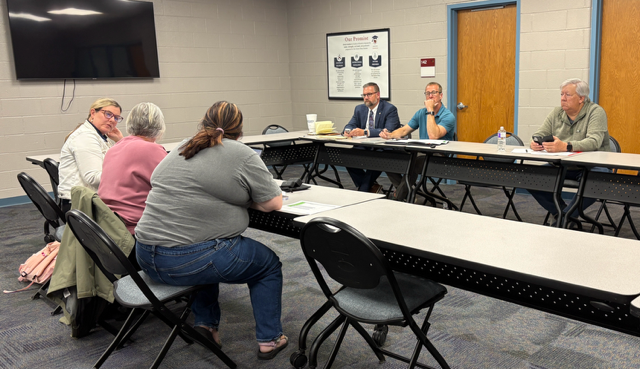
In other business, the board discussed the budget. While the district has not yet created its budget for next year, it already plans to operate at over a half a million deficit in new revenue.
Moeckel said the projected new funding for next year is almost $450,000. This assumes $5,782 per student.
The district has new projected expenditures of $970,780. So, Moeckel said the district is “already in the hole $521,000.”
“We are going to have to shift roles. We’re going to have to reduce staff through attrition,” he said. “We’ve already done a majority of that. You saw, in the last several months, that we’ve had people that resigned.”
This attrition, or gradual reduction of the district workforce, means that people will not be hired to fill these positions.
Most of the increased expenditures are due to special education assessments and debt reductions, Moeckel said.
Since it is part of an interlocal special education agreement, the district must pay assessments each year. Moeckel said assessments used to be lower, but they are increasing. He said student special education needs are increasing.
He also said the budget was not spent in the most forward-thinking way in the past.
“That leads to a larger than we’ve seen in many, many years, if ever, SPED assessment,” Moeckel said.
Moeckel also said declining enrollment is a factor in the budget. The upper grades have larger class sizes than the lower grades, so enrollment will decrease as students graduate.
“We’ve always thought of ourselves as a 1,700 district. We’ll be a 1,400 or a 1,200 district,” Moeckel said. “But what a 1,200 or a 1,400 school district can do, compared to a 1,700 district, is different.”
Board member Heather Whalen said the district’s upper four grades have 564 students, while the lower four grades have 399 students.
“That’s how stark that is,” Whalen said.
Moeckel said this issue is not unique to Eudora, as districts across the state are dealing with declining enrollment.
The board approved enrollment projections, including the nonresident capacity, for next year. With current enrollment projections, the district can take 261 nonresident students next year while still maintaining student-teacher ratios and physical space needs.
Moeckel said interested families have to apply. If more students apply than there are available spots, then it will go to a lottery. Moeckel said that has not happened since the district standardized its process with the state.
The district does not accept out-of-district students indiscriminately, Moeckel said. If students have issues, like a previous expulsion, he said the district won’t enroll them.
“I think sometimes that’s sort of a confusion in the community and even across the state is, well, ‘If they want to come in, they can come in,’” Moeckel said. “That’s not how it works.”
Some people with Eudora addresses are considered nonresident students because of the small size of the district, Moeckel said.
In other business, high school Principal Bill DeWitt gave an update on the cellphone policy implemented at the beginning of the school year. He said 77% of students have not had any violations this year.
He said the school will have to change its policy for next year following the state’s new cellphone ban law.
Moeckel said the district is still trying to understand whether it is required to purchase some sort of box to hold students’ phones at the high school.
He said the district treads on thin ice because it has little enforcement mechanisms besides searching a student when they walk into school and say they don’t have their cellphone.
The district is a long way from a new policy, and Moeckel said it is welcoming any advice from its legal team.
“I think the intent is really good,” Moeckel said. “It comes into how it’s actually put into place. I don’t want to overburden our staff. I don’t want to overburden our admin.”
The new law also prohibits school staff from communicating with students through social media and private messages, which Moeckel said he supports.
In his presentation, DeWitt shared the results of a survey given to highschoolers last fall. Four out of five students reported earning A’s and B’s, and 92% said they feel safe. Over 85% said they feel respected by staff, and 81% said they are involved in activities.
He said 11th graders reported feeling the most stressed and disconnected, like quitting certain extracurriculars. Additionally, seven out of 10 students said they know about school support resources but don’t use them.
Only a quarter of students said they feel clear about their post-secondary plans. Of the seniors specifically, 45% said they were very clear with the post-secondary plans.
Whalen asked DeWitt if the district can implement any strategies at the high school to help kids find out what they enjoy and are good at.
DeWitt said he thinks the key is changing the narrative that you don’t have to go to a four-year college to be successful. He also said the high school is trying to communicate as much information as possible with parents.
Moeckel said the issue is not a lack of programs, but the lack of a coordinated system to support students.
“We want to continue to build our strong programming partnerships, but we have to make sure they’re connected,” Moeckel said.
He said this need for connection is why the district created a new role and hired Shanda Hurla. Her role will be to connect internships, scholarships and pathways into one coordinated system, according to the presentation.
In the survey, students said they need the most support with college applications, financial aid and career exploration.
Moeckel said students don’t need to be certain on what they want to do, but they should know how to navigate a path.
Board member Claire Harding asked if the high school plans to do another student survey, and DeWitt said it will in the fall and spring of the next school year.
“Student voice is really important,” Harding said.
In other business, the district discussed computer purchases. A new, cheaper MacBook, called the MacBook Neo, came out in March. Moeckel said the district could buy 600 MacBook Neos for the high school for $78,000 per year, which is cheaper than buying Chromebooks every year. He said these MacBooks would be paid off in four years.
Technology Director Ron Long said grades five through eight would continue using the district’s newer Lenovo computers.
The board did not take any action on a computer purchase.
The board did approve an increase in the Early Learning Center tuition. Starting in the fall, tuition will increase from $250 per month for in-district students to $350. Tuition for out-of-district students will increase from $350 per month to $700.
Director of School Improvement Services Heather Hundley also gave an update on the district’s strategic plan at the meeting. The public has access to a continuously updated strategic plan school statistics dashboard.
The board went into executive session for almost an hour for personnel employer-employee negotiations. It took no final action.
Reach Bella Waters at [email protected].