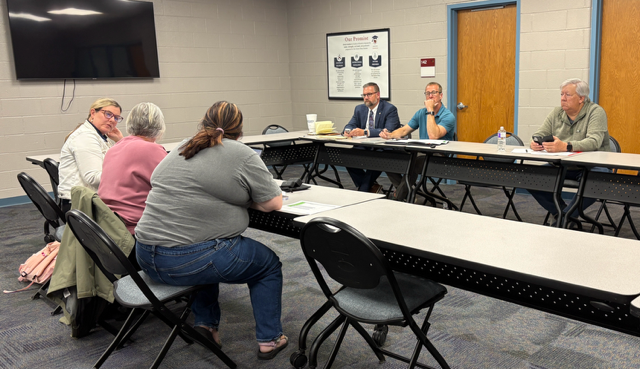














Coaches will no longer be able to be hired using fundraising funds under new district guidelines discussed by the School Board at its meeting on Thursday.
Superintendent Stu Moeckel and Athletic Director Cara Kimberlin worked together to make a draft of the new guidelines. Moeckel said he hopes to have something official in place by the start of the new school year.
The new guidelines state that “funds raised through any district-approved fundraising activity shall not be used to hire coaches, assistant coaches, sponsors or other paid staff.”
Board member Heather Whalen said she wants coaches to have a clear path forward for how to ask for new coaches.
Board member Joe Hurla said he doesn’t want the hiring procedures for coaches to seem like the whole focus of the guidelines, though.
“That’s part of what we’re doing, that’s one of the results,” Hurla said. “We’re trying to solve the big problems.”
All new fundraising initiatives must also receive prior written approval from the building principal, athletic director and superintendent under the new guidelines. Existing longstanding fundraisers may continue as long as they remain in compliance with procedures and pass annual administrative reviews.
The new guidelines also reaffirm the distinction between the district and outside booster organizations. Any outside fundraising must state that it’s not sponsored or affiliated with the district. Moeckel said the district hasn’t had any problems with this, though.
“It’s not in an idea of trying to stop people from doing it,” Moeckel said. “It’s just an idea of this isn’t part of the school’s function.”
Board member Tony Barron asked if the district tracks booster money, and Moeckel said no. Moeckel said booster contributions more often come in the form of gifts, like meals or new uniforms, rather than cash donations.
The new guidelines also include an equity section, which states that all district fundraising activities must avoid placing undue pressure on families. Moeckel said he is hesitant about this language, though, because undue pressure could be $5 or $200.
Moeckel also said that if families are donating, the district wants that money going to their children for that year. Whalen said families should be able to see the benefits of their contributions.
Board member Claire Harding asked about what this policy will look like in practice, and Moeckel said the board will put something together this summer that it will share with the coaches and fundraising groups. He said the board will next discuss this in May.
The board also began discussions on its budget for the next year.
The board projects to receive $337,456 in new funds based on current enrollment. The district expects to receive $5,782 per student. It also projects a supplemental general increase of $111,360. This amounts to nearly $450,000 in new funds.
The district is projecting almost $1 million in new expenditures. The biggest chunk of this is the special education debt reduction, which is projected at $626,014. Moeckel said this number became high due to issues like insufficient state funding.
With a total projected revenue increase of $448,816 and total projected expenditures increase of $970,780, the district expects to go over half a million in the negative in new funds.
“Napkin math, that’s not a good situation to have,” Moeckel said. “What happens next year, you’re already going to be short.”
Board member Zach Brooks asked what the budget would look like if the state fully funded special education, and Moeckel said the district would get an extra $1,000 per student, or $1.7 million. Hurla said this is deceptive, though.
“It’s only deceptive in that we would have $1.7 million more this year, which would ease this burden,” Hurla said. “But also, we would have had it over the last X number of years where we wouldn’t have accumulated this debt.”
The board also mentioned declining enrollment as a cause for concern. Moeckel said stagnant or declining enrollment would be detrimental to students because programs and options schools have always had will be eliminated.
Board President Mark Chrislip said he hopes some of the housing projects around town help with declining enrollment.
In other business, Moeckel gave an update about education bills in the state Legislature. One bill would implement a statewide cellphone ban in schools. The district already has a cellphone policy, but Moeckel said any state law would trump the district’s. The bill requires students to lock away their phones at the beginning of the school day, which Moeckel said is unspecific.
“If the governor signs it, we will get you some more information,” Moeckel said.
This cellphone ban also prohibits staff members from being friends with students on social media. Moeckel said he agrees with this but would like more clarification on exceptions, like student family members.
Other education legislation includes SB 387, which would require the district to audit every student who uses at-risk funding. Moeckel said the district only randomly audits 7% of those students right now. Another bill would require instruction regarding communist and socialist regimes and require students to pass an American civics course for graduation.
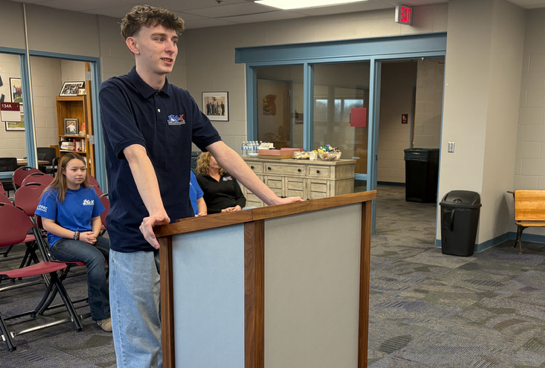
In other business, high school students in JAG-K presented to the board about how the organization has helped them.
“JAG has helped me so much, like talking in front of people, talking to people,” said junior Neo Allison, who has also been chosen as the state secretary for JAG-K.
Moeckel said the district made a great hire with Dana Chance, who he said “built this program literally from the ground up.” He said he wishes the district could utilize JAG-K’s model for all students because he’s seen the growth in students like Allison.
The district also approved two bids for a roofing project at the transportation building and districtwide internet during the meeting.
Premier Contracting will complete the construction on the roof, which Moeckel said is an overlay rather than a total replacement. It will cost the district around $100,000 and will be paid with bond funds.
The district has a contract with Midco that ends in June, and it has chosen Kansas Fiber Network as the replacement. Technology Director Ron Long said 60% of the cost is expected to be covered by the Federal Communications Commission E-Rate program. The district has worked with KFN before.
Harding asked if losing the federal E-Rate is a worry, and Long said no.
The district is also considering switching to the new Macbook Neos instead of Chromebooks, but no official plans have been made.
The board went into executive session and approved the extension of returning administrators’ contracts for the 2026-27 school year. Moeckel said the district determines raises for administration staff the same time as it determines raises for teachers in the summer. He said the only action taken Thursday was extending administrators’ contracts.
It also accepted the resignations of high school ELA teacher Tommie Cassen, elementary school assistant principal Sarah Miller, early learning center teacher Melinda Neeley, elementary school stage production staff member Emily Shrimplin and high school assistant volleyball coach Mandy Shockley.
It approved the employment of middle school assistant track coach Clayton Neas and non-traditional enrollment specialist Molly Pratt. Fifth grade teacher Jennifer Decker will also become the new school counselor.
Reach reporter Bella Waters at [email protected].